

Madeira Desouza of Las Vegas has gained a reputation for his unique and captivating creative works popularized in the internationally famous adult playground called “Sin City.” He became a year-round resident of Las Vegas in 2012 after he relocated from the Washington, DC area.
If you would like to contact the author, send email to: madeira.desouza3d@gmail.com. See additional contact information.
If you are a blogger, podcaster, YouTube content creator or other media writer, the Clavius Deep website has a high degree of background information about the author that can help you write an article or commentary. He is available for interviews.
Listen to podcasts hosted and produced by the author.
Pen Name
He is a citizen of the United States, born in California. His heritage is Portuguese from both his parents, the late Edward and Evelyn Goulart. He is known to most people by his nickname, Woody.
The word madeira is Portuguese for wood.
The surname Desouza is a variation of the surname Souza from his old country grandfather on his mother’s side.
The year 1996 was the first occasion in which he published online under the pen name of Madeira Desouza. In 2007 he branched out into creating original 3D digital images for online publication also using that same pen name.
Protected by U.S. Copyright:
Certification of Registration under the seal of the Copyright Office in Washington, DC.
- Registration Number: TX8-423-630
- Effective Date of Registration: May 31, 2017
- Title of Work: Baja Clavius: Moon Men Deep Inside
- Copyright Claimant: Elwood Franklin Goulart
- Year of Completion: 2017
- Date of First Publication: May 8, 2017
- Nation of First Publication: United States
- Multiple ISBN numbers are on file:
Original (2017) — ISBN 978-1521252666
2018 — ISBN 978-1719830430
2020 — ISBN 979-8678442765
2026 — ISBN 979-8180861856
Photos: |
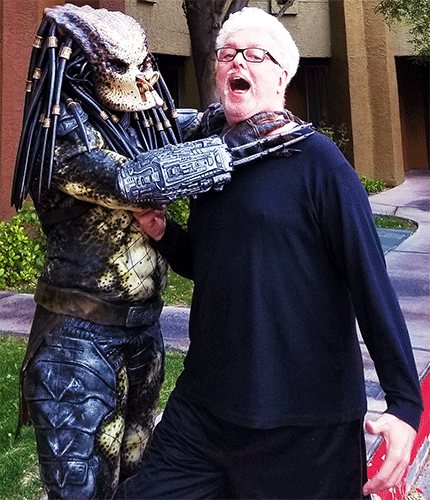
That’s Madeira Desouza in the photograph about to be killed by the Predator who appeared suddenly one day in Las Vegas, Nevada for no apparent reason.

That’s also Madeira Desouza in the photograph taken in 1891 or 1991 in historic Deadwood, South Dakota. You can see clearly that Madeira Desouza posed for this photograph holding a shotgun. Why did he choose a shotgun for this photograph? His mother’s father brought deep, enduring shame upon the family through a murder/suicide when Madeira Desouza was only a year old. That man he never knew used a shotgun to kill his wife (his mother’s mother) and then he turned the gun on himself. That violent family tragedy influenced Madeira Desouza’s emotional sensibilities as a storyteller in adulthood.
Books Similar to Clavius Deep
Five Comparable Titles and How They Resemble Clavius Deep
1) Blindsight — Peter Watts
Blindsight shares Clavius Deep’s rigorous engagement with first-contact that is intellectually unsettling, and it foregrounds neuroscientific themes and the limits of consciousness. Both novels feature alien intelligences that challenge human sensory/mental frameworks (compare Watts’s nonstandard aliens with the Ezuoia’s noncorporeal, quantum-linked presence.) The cold, clinical atmosphere of mission teams facing incomprehensible otherness is a thematic match.
2) The Sparrow — Mary Doria Russell
The Sparrow explores first-contact, religion, and the moral costs of intercultural (and interspecies) encounter. Clavius Deep likewise interrogates religious formation around an extraterrestrial phenomenon (the MMDI cult and Yotaro Tai; and the ethical consequences for missionaries/agents), making The Sparrow a useful comparative for readers who appreciate spiritual and ethical fallout from alien contact.
3) Childhood’s End — Arthur C. Clarke
Clarke’s classic interrogates what alien benevolence — or inscrutability — does to human institutions, religion, and identity. Clavius Deep similarly presents an alien encounter that reorders human belief systems (the Colossus of Clavius and subsequent cult; and asks how humanity adapts to being objectively known and influenced by nonhuman intelligences.)
4) The Three-Body Problem — Cixin Liu
Liu’s novel shares the scale of consequence and geopolitics surrounding an extraterrestrial discovery, and both texts tie scientific revelation to international institutions and cascade effects through time. The Three-Body Problem’s focus on clandestine scientific history and cross-national consequences echoes the Chinese discovery of the Colossus and the global, institutional management of time-travel knowledge within MMDI.
5) 11/22/63 — Stephen King
King’s time-travel novel is a strong point of comparison for its narrative emphasis on the moral complexity of changing the past, the procedural detail of embedding in a prior era, and the psychological cost for the time traveler. Clavius Deep contains many mission-oriented inserts into historical timelines (Arizona 1991, Geneva 2194, Amargosa 2012; and investigates the personal and institutional fallout of repeated timeline interventions.
Notes on similarity criteria:
Each suggested title was selected for overlap in at least one major axis present in Clavius Deep: deep first-contact ontology and its cultural/religious effects (The Sparrow, Childhood’s End), rigorous exploration of consciousness and alien cognition (Blindsight), institutional geopolitics entwined with cosmic discovery (The Three-Body Problem), and the moral & procedural complexity of altering history through time travel (11/22/63). These comparisons provide market context for positioning and for readers to manage their expectations.